
Introduction
Buying health insurance is an important decision, so most people seek out an advisor to help them find, explain and negotiate a plan that fits their circumstances. The difference is who that advisor works for: an agent is appointed by one insurance company, while a broker holds an independent licence and shops around on your behalf.
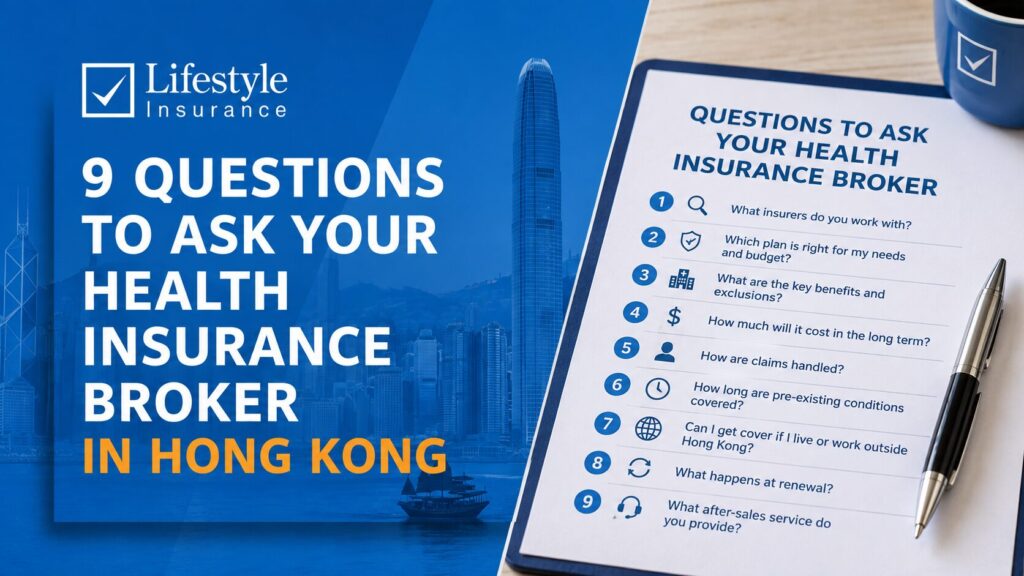
Do you have the right health insurance broker? Here is a 9-point checklist of questions to ask,so you can make the right decision.
What is an insurance broker? Understand a broker’s job duties in our guide.
Key takeaways
- Brokers represent you while agents represent the insurer
- Brokers hold agreements with and compare many different providers
- Both services are free as commission is included
- All licensed intermediaries appear on the IA public register
- Discuss claims support before buying your insurance plan
Choosing between the two comes down to whether you want one product explained or the whole market compared.
1. What are your qualifications?
Every individual and company advising on insurance in Hong Kong must hold an Insurance Authority licence, and the register listing them is open to the public.
A licensed broker has to meet a set minimum standard:
- Be at least 21 years of age
- Be a Hong Kong permanent resident, or hold an employment visa that does not restrict them from insurance broking work
- Have a minimum education standard of Form 5 or equivalent
- Have either a minimum of two years’ experience as a manager in the insurance industry, or have passed the Insurance Intermediaries Qualifying Examination (IIQE) recognised by the Insurance Authority
The regulator itself changed in 2019, as licensing used to sit with industry bodies like PIBA and HKCIB, but from 23 September 2019 the Insurance Authority took over licensing, inspections and discipline directly. An advisor still citing an old SRO number is quoting a system that no longer issues licences.
➜ Lifestyle Insurance: Our advisors are individually licensed and IIQE qualified, operating under Insurance Broker Company Licence No. FB1187. Any one of them can be confirmed on the IA’s public register in under a minute. Some advisors take it upon themselves to further their learning and are associated with both local and overseas regulatory learning faculties, obtaining Chartered status.
2. How many insurers do you work with?
This is the question that tells a broker apart from an agent. An agent is tied to a single company, whilst a broker earns the right to place business with each insurer separately, so a wide panel represents years of agreements built one at a time.
A broker assesses each insurer before taking them on, looking at the products, how they underwrite, and how reliably they settle claims. A shorter panel that has been properly vetted can serve you better than a long one that hasn’t.
Ask for the number, and ask to see the list of their providers.
- Brokers must earn their partnerships with every insurance provider
- Quality matters more than total number of insurer partners
- Good brokers only recommend insurers with solid claims support
- Always confirm if their provider list is publicly available
➜ Lifestyle Insurance: We place cover with 30+ local and international health insurance providers that have been carefully chosen and repeatedly tested over the years.
3. Do you charge any fees?
Brokers are paid by insurance companies. They receive a commission on each successful policy they place with the insurer
Buying through a broker is therefore free of charge to you. Premiums are set by the insurer, and the commission is already built into the price, so it costs the same whether you go direct, through an agent, or through a broker. Therefore, using a broker is free of charge to you.
➜ Lifestyle Insurance: We charge no fees for advice, comparison or claims support. We are remunerated by the insurers, and we are not paid to recommend any specific provider.
4. How will you handle my application and underwriting process?
The application is where a broker does work the insurer will not do for you. They complete the forms alongside you, present your case, and manage it through to the day your cover begins.
It counts for most when your medical history is involved. A broker can put one application to several insurers at once, and knows from experience which of them tends to take a given condition more favourably.
- Brokers can approach several insurers on your behalf
- Pre-existing conditions are underwritten differently by each provider
- Loadings and exclusions can often be negotiated or reconsidered
- Avoid unfair exclusions by exploring alternative market options
➜ Lifestyle Insurance: We prepare the application with you, approach more than one insurer where it improves your terms, and set out any loading or exclusion in writing before you agree to anything.
5. What happens when I need to make a claim?
When you need to make an insurance claim, your broker acts as your personal advisor. They will collect your details, review your policy to confirm coverage, handle the paperwork, and manage all communications with the insurance company to ensure you receive a fair and timely payout
Medical claims are settled in one of two ways. With direct billing, the insurer pays the hospital directly, and with reimbursement, you pay first and claim the amount back afterwards.
- Direct billing avoids paying large hospital bills upfront
- Guarantees of payment are arranged before planned admissions
- Declined claims can be appealed through your broker
➜ Lifestyle Insurance: Your advisor can assist with your claim. He or she arranges a guarantee of payment for planned admissions, and in the unlikely event of a claim being declined, we will challenge it in your behalf.
6. What happens at renewal, and will my premium rise?
Renewal is the point where you find out whether you have an advisor or a salesperson. Notices arrive 4 to 6 weeks before your policy anniversary, and what happens next is what separates the two. Your advisor should then reach out to process the renewal and present alternative options from the market where relevant.
Expect the premium to climb, for two distinct reasons. Medical costs in Hong Kong have been rising at roughly 9% a year, and high-end plans have seen sharper jumps still. On top of that, age banding steps your premium up each time you move into a new age bracket.
- Medical inflation lifts premiums across the whole market
- Age banding adds a separate rise at set ages
- A steep renewal is usually both at once
Switching insurers at renewal means being underwritten again. Any condition diagnosed since your original application can be excluded or loaded by the new insurer, so a lower premium is not always the better outcome.
➜ Lifestyle Insurance: Our advisors handle renewals themselves. We review your plan against the market each year and tell you plainly when staying put works out better than moving.
7. Who are your typical clients?
A broker’s usual clients tell you where their real strengths lie, and how much focus your case will get. A firm built around large multinational accounts handles an individual policy differently from one that works with families and expats every week.
- Individual, family and corporate cases each need different things
- Expat cover raises portability questions local cover does not
- The right broker regularly handles cases that look like yours
Client type also shapes how many lines of cover a broker handles. Families and business owners rarely need health insurance alone, and an advisor who only places medical cover refers the rest elsewhere.
➜ Lifestyle Insurance: We advise individuals, families, expats and SMEs from our Sheung Wan office, and have done since 2010. One advisor can look after your health plan, your family’s protection and your company’s employee benefits together.
8. How much does health insurance actually cost in Hong Kong?
Private healthcare in Hong Kong ranks among the most expensive anywhere, and comprehensive international cover reflects that
- 28 year old female: from US$3,866 per year
- 35 year old single male: from US$4,449 per year
- 40 year old couple: from US$9,469 per year
- 40 year old couple with one child: from US$12,370 per year
Premiums vary widely around these figures, and four factors account for most of the difference. The same person can pay double or half depending on how the plan is structured.
- Area of cover, with worldwide including the USA costing most
- Deductible level, where a higher excess lowers the premium
- Whether outpatient and dental modules are included
- Age at application, as premiums rise with each age band
A serious surgery in the private sector can run to HK$500,000, and cancer treatment to HK$1,000,000, which is what comprehensive cover is designed to absorb.
FAQs
An insurance broker compares plans from multiple insurers, explains the differences, and arranges the cover that fits your situation. They also handle the application, the renewal each year, and any claim you make.
An agent is appointed by one insurance company and sells only that company’s products. A broker holds an independent licence and can compare and place business with several insurers on your behalf.
You see the whole market rather than one insurer’s range, at no additional cost. A broker can also approach several insurers if you have a pre-existing condition, and represents you rather than the insurer when a claim is disputed.
